 Book Reviews
If there’s one thing we’ve come to expect from cartoonist Tom Gauld, it’s that we should expect the unexpected. Then again, he’d probably laugh at us for using such a lazy logical paradox and mock us in one of his cartoons. There are worse things than to inspire greatness, I suppose, and we’d be in good company.
In collections like Baking With Kafka and Revenge of the Librarians, Gauld turned his sardonic wit and good-natured ribbing towards bibliophiles and the books they cherish (they were long overdue for a comics comeuppance), while Physics for Cats follows the path set forth by his Department of Mind-Blowing Theories, once again collecting dozens and dozens of comics from New Scientist where (what else?) science is the subject du jour.
While he’s easily the most successful blender of science and comics since Gary Larson unleashed his cows and amoebas decades ago with The Far Side, Gauld has yet to achieve the ultimate prize bestowed on science-adjacent cartooning, having a parasitic insect named in his honor, he could certainly do worse than a chewing louse.
And just like Larson, Gauld is able to interpret the wacky, often wonderful world of science in layman’s terms without dumbing down the elements that make it so wacky and so wonderful. Sometimes this means a visual pun, or maybe a turn-of-phrase. Others may have you racing for an encyclopedia (*cough* wiki). It’s nerd humor, just with more killer robots, giant monsters, and smashing subatomic particles on the beach. One should never have to compromise for a little fun in the sun.
Despite the title, Physics for Cats is sadly light on actual cat comics, though there’s plenty of non-feline funnies that play with the very concepts of time and space, often at the same time, petty rivalries, profound discoveries (and abject failures), and a reminder that sometimes the only difference between chastisement and adulation is who’s doing the judging. Welcome to Science: the only field where disproving theories is the key to success!
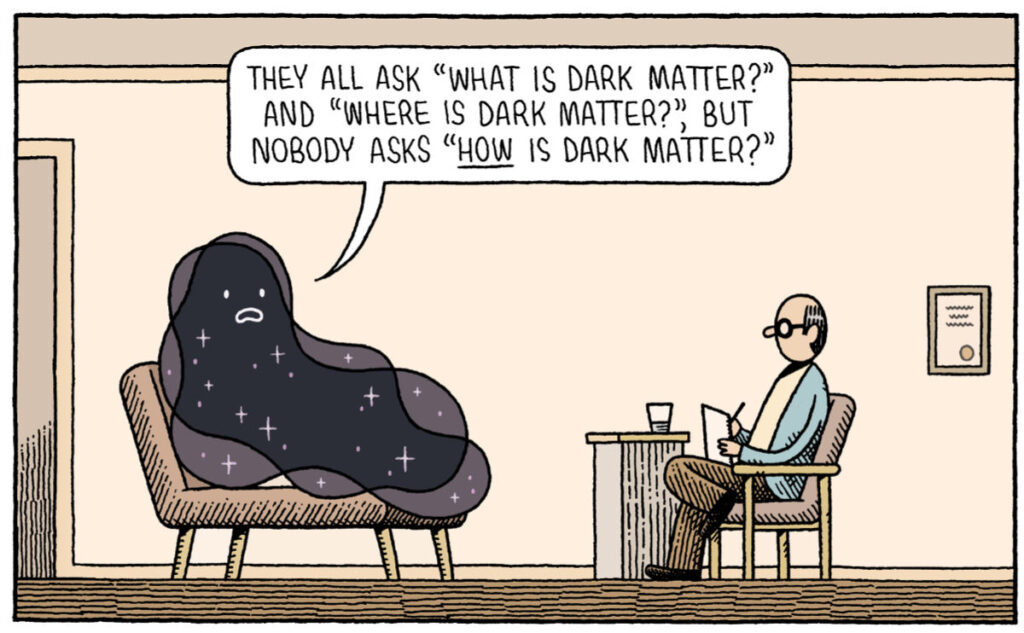
Highlights include a dejected blob of hypothetical matter sitting in therapy, pondering its(?) mental health. “What is dark matter?” and “Where is dark matter?” But nobody asks “How is dark matter?” We can all relate. Sometimes when you stare into the Abyss, the Abyss stares back. Other times you meet the Abyss for a lunch date of coffee and chatting.
Two prisoners are chatting in their cell, one asks the other what he’s in for. “I’m a mathematician. I did groundbreaking work with imaginary numbers.” They put you in prison for that?, asks his cellmate. “They did when I used them in my tax returns.” Groucho Marx would be jealous.
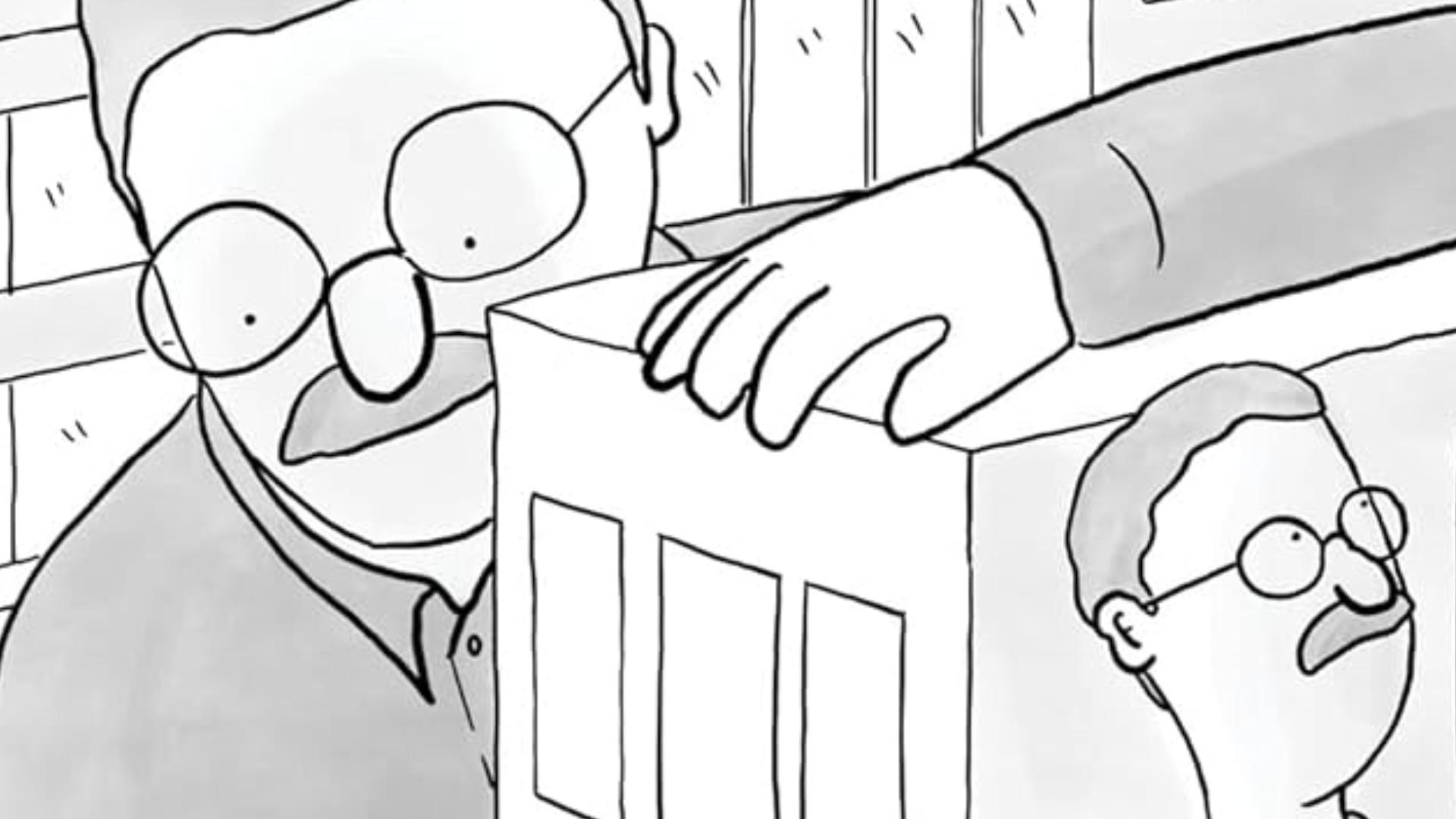
King Arthur’s Excalibur gets reimagined as an impenetrable mass of tangled cables (thus reimagining the King of England as a department head). Or the infamous Trolley problem gets updated with Salvador Dali-styled surrealism. And remember: “Plagiarism is such an ugly word. I prefer to say ‘credit-free externally harvested concept redistribution.”
I’m not saying that reading Physics for Cats will make you smarter, or even more scientifically literate, but I’m not saying it won’t do those things, either. Nothing in life is guaranteed, though there are scientists who’d propose a theory about absolutes while others would argue against it, thus giving Tom Gauld fresh inspiration for his next comic that would, inevitably, be included in his next collection. Such is the cyclic nature of science and comedy, two fields that go together better than anyone expected. Apart from Larson and Gauld, that is.

 Game Reviews

 Movie Reviews
 Tech Reviews